
Family storytelling · Guide 05
Turn a family memory into a bedtime story
A walk, a lost mitten or a cake that went sideways can become tonight’s story. Start with one small moment; use the questions and finished example below.
The short answer
Keep one real detail. Add one small adventure.
Choose a memory, give a character something to do, add a manageable obstacle, then bring the story to a clear ending. Write five sentences first. Add a little dialogue and one imagined surprise, and you have a story you can read aloud.
Which family memory could become a story?
Choose a scene you can picture: the puddle by the gate, a floury kitchen table, a bus ride with a grandparent. A whole holiday is hard to fit into a short tale. The afternoon you rescued a hat from a hedge already gives you a place, a problem and an ending.
Pick a memory the people involved are comfortable revisiting. Ask before using another adult’s personal story, especially if you might share it outside the family. Leave out a child’s embarrassing moment if they dislike hearing it. An ordinary happy detail is plenty to begin with.
PBS KIDS for Parents offers a related activity from Fred Rogers Productions: making a handmade book around a family memory. See the family storybook activity.
Ask a grandparent for a memory. A photograph or a familiar object can give you somewhere to start the conversation.
Notes before sentences
Eight questions to find your story
Use these family story prompts for kids as a conversation, or answer them yourself. A few words per question are enough. Your child can choose one detail without helping to write the whole tale.
Where were we?
Name one place and one moment: outside the garden gate after rain, rather than everything that happened on Sunday.
What small detail do we remember?
Choose something you could see, hear or touch: a yellow leaf, squeaky boots or the smell of warm bread.
Who will the story follow?
It can be your child, an invented child, an animal or the object itself. Give one character the main action.
What does that character want?
Keep the wish simple: launch a boat, find a mitten or carry a cake home. It gives the story somewhere to go.
What gets in the way?
Try a small obstacle: a pebble blocks the boat, or the bag will not close. A bedtime tale needs no frightening danger.
Who or what could help?
A relative, a breeze or a talking sparrow can offer an idea. This is a good place to add one imaginary element.
What does the character try?
Choose an action the listener can picture. The child moves a twig, follows a sound or finds a lighter passenger.
Where does the adventure end?
Give the story a place to rest: the boat reaches its harbour, the mitten finds its pair, everyone goes home.
Turn your answers into five sentences
Copy this outline onto paper and fill the brackets. It gives you a beginning, a middle and an ending before you work on the wording.
- 1. A familiar beginning
- One [day], [character] was at [place], where [remembered detail].
- 2. A wish
- [Character] wanted to [small goal].
- 3. A problem
- But [obstacle] stopped the plan.
- 4. An attempt
- With help from [helper], [character] tried [action].
- 5. A resting place
- At last, [result], and [character] [quiet final action].
Read those sentences in order. If the action makes sense, add a spoken line and a detail you enjoy. If it wanders, remove a character or a second problem. Keep the ending visible while you expand the middle.
An original story to read aloud
The Leaf Boat
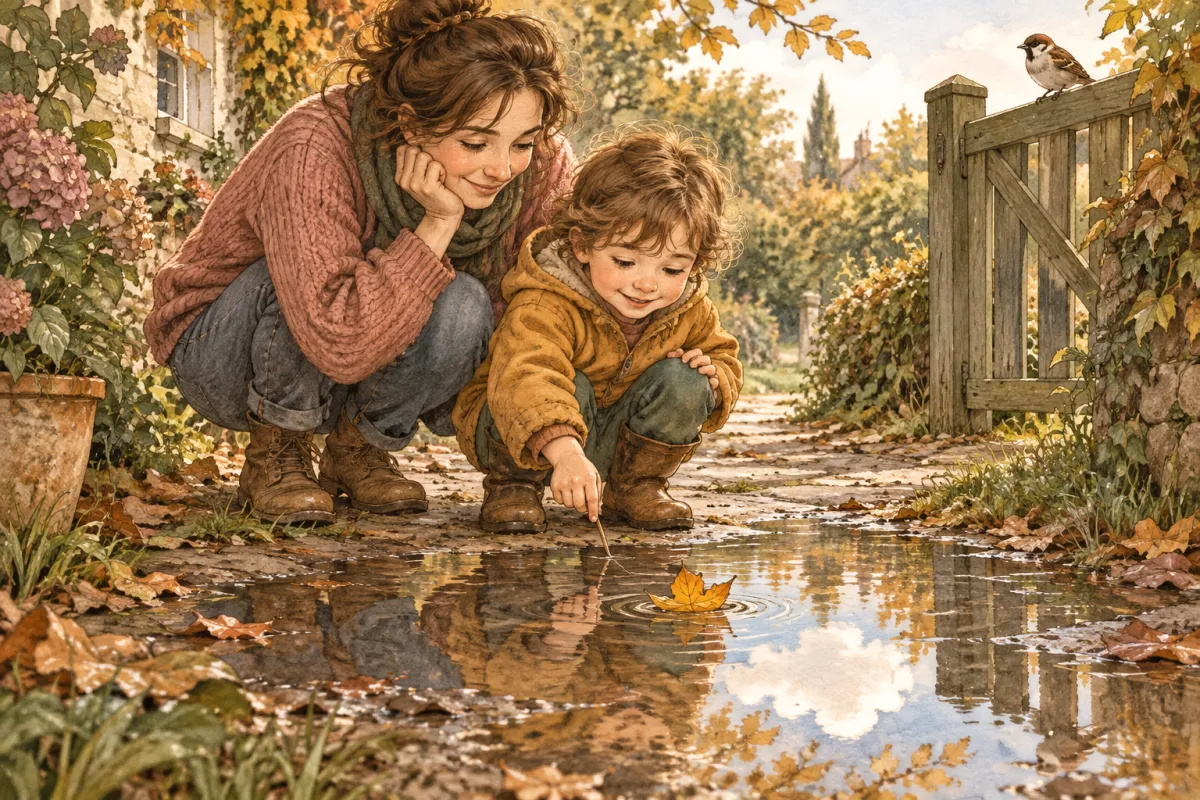
This invented example starts with an ordinary family scene: a child and a parent sailing a leaf in a puddle. The talking sparrow and cloud passenger are the fairy-tale additions.
On Sunday, Mina and Dad found a yellow leaf shaped like a little boat. They placed it in a puddle beside the garden gate.
“Where shall it go?” Dad asked.
“To the sea,” said Mina. But the leaf bumped into a pebble and stopped.
A sparrow landed nearby. “I know the way to the sea,” it chirped. “First you must carry something worth taking.”
Mina searched her pockets. She found a button, a smooth stone, and a piece of string. They were all too heavy.
Then she noticed a cloud reflected in the puddle. “Could you carry that?”
The leaf rocked gently. The cloud settled into its yellow middle, soft and white.
A breeze pushed the little boat past the pebble. It sailed around Dad’s boot and between two islands made of mud. Mina walked beside it, pointing out each new place.
At the far edge of the puddle, the leaf reached a patch of grass.
“This isn’t the sea,” Mina said.
“No,” said Dad. “But look who came along.”
The cloud still floated above them. The sparrow was waiting on the gate. And their little boat had brought them all the way across a whole afternoon.
Mina lifted the leaf onto a flat stone.
“Your harbour,” she told it.
Then she and Dad went inside. Mina left her boots by the door and went to the window for one last look.
The yellow boat looked very small, and the sky above it looked very wide.
Make the story your family’s own
Keep the detail that belongs to you
Swap the garden gate for your street, Dad for another familiar adult, or the yellow leaf for a curled brown one. Keep a favourite family word. These small choices make family storytelling ideas feel personal without adding a long family history.
Say where make-believe begins
Try: “We really sailed a leaf that day. I made up what the sparrow said.” If you want an accurate keepsake too, save a separate note with the place, people and what happened. The fairy tale can then change without replacing your record of the memory.
Let the listener set the size
For a shorter version, keep the leaf, the pebble and the harbour; skip the pocket search. A child who wants to contribute could name the boat or suggest its passenger. Keep their favourite idea, but let listening be enough if they would rather not join in.
Read it aloud, then decide whether to record it
Finish the text before opening a recorder. Say the names aloud, split any sentence you stumble over, and check that you know who is speaking. Read the ending too: it should finish the adventure rather than open another problem.
To preserve your exact reading, record the whole story on a phone. That keeps your own pauses, laughter and pronunciation. Our guide walks you through a short sound check and saving the finished file: how to record a bedtime story.
You can also leave the text ready for another evening. There is no need to write, rehearse and record at bedtime. For tonight, try the choices in our guide for parents who are too tired to read.
In preparation · iOS and Android
Your finished text, prepared for listening
Sleep2Story is being built to turn the complete story text an adult supplies into synthetic narration, using a consenting adult family member’s voice sample. The planned app includes a personal story library and player. It does not write the story or preserve that adult’s original reading of those words.
The app is still being prepared for release. Narration is planned for English and Russian; other website languages do not mean narration is supported in those languages. You can write, read and make an ordinary phone recording of your family story now.
See how Sleep2Story works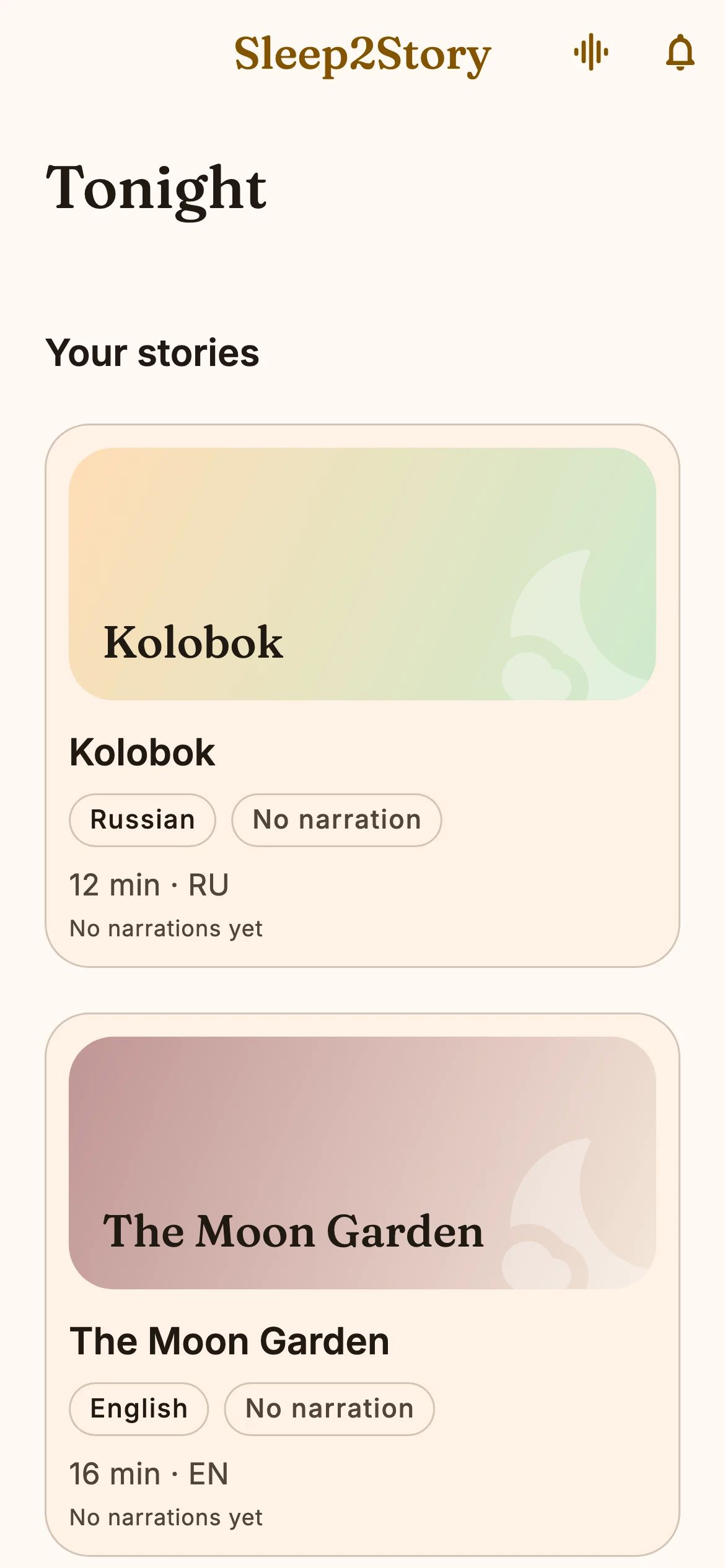
Questions parents ask
Questions about turning memories into stories
Must every detail be true?
No. Tell your child which part you remember and which part you invented. If you also want a family record, keep the factual notes separately from the fairy tale.
Can we invent the main character?
Yes. A fox, a toy boat or an invented child can take the place of a real person. Keep one familiar detail so the story still connects to the memory.
What if my child does not want to join in?
Write it yourself and offer it as a story to hear. Your child can listen, choose a name later, or ask for a different tale. Participation is optional.
How long should our family story be?
Start with the five-sentence version and read it aloud. Add details if you both want more. Choose an ending you can reach comfortably; there is no required reading time.
Does Sleep2Story write the story for me?
No. The adult supplies the complete text. Sleep2Story is being prepared to generate English or Russian narration from that text and a consenting adult’s voice sample. It is not yet available in app stores.
When your story is ready
Source and editorial note
The PBS activity suggests making a book from family memories. The eight questions, five-sentence outline and The Leaf Boat are original Sleep2Story editorial material. The example is fictional, not a family testimonial; the source does not evaluate Sleep2Story.